If I could go back in time to when I was just starting out, I’d create a multi-person band named Theseus. My goal would be for the band to exist long enough that all the original members had left the band, to be replaced by younger players.
Rob Reviews: 100 Years of Horror (1996)
Wherein Rob Reviews Everything He’s Ever Seen, Read, Heard, Experienced or Thought
I’m doing a review of every TV show my Watched media list says I’ve seen.

I don’t know for a fact that I watched all 26 episodes of 100 Years of Horror. But that is what it says on my Watched list, and we are taught to trust spreadsheets, are we not? Either way, I have a pretty strong feeling I watched a healthy chunk of it.
In an attempt to jump-start my addled brain, I searched YouTube and found the first four episodes sitting there waiting for me. I clicked on episode one, “Dracula and His Disciples,” and within two minutes, I realized I need to watch this entire series again—which I definitely will.
The bad computer-graphics of the ridiculously over-long intro made me smile. It looks like it was rendered on a Commodore 64. But the moment Sir Christopher Lee utters his first couple of words, I was hooked all over again. There is nothing better, it turns out, than hearing Christopher Lee say the word Drac-oo-la. The man delivers every single syllable like he’s presiding over a Victorian execution.
The show systematically breaks down iconic sub-genres—Scream Queens, Mutants, Giants, and beyond—loading up on vintage clips from Universal Classics and Hammer Horror. It mixes in talking-head commentary from genre royalty like John Carpenter, Roger Corman, and Bela Lugosi Jr., all bathed in that distinct, cozy 1990s basic-cable lighting. But Lee is the glue. His smooth, velvety gravitas elevates bargain-bin monster footage into prestige television.
My Rating: 3 out of 5 Vampire Capes.
Absolute recommendation for anyone who considers themselves a horror fan—especially those who think the first Saw movie counts as “old school.”
How’s Your Morning Going?
Woke up way too early this morning. Like, still dark early. Because of a pain in my hip and lower back. Likely need a new mattress.
Because I use a CPAP machine -it really works well for me, i sleep much better – I find I can only sleep on my back. Being ‘stuck’ in this position likely exacerbates the back/hip pain. Sometimes, like this morning, when the pain and stiffness is pronounced, I take off the CPAP and move my body onto one side or the other to find relief. I am so used to the CPAP machine that I find it hard to sleep without it. This morning – this too-early dark morning, lying on my side and finding no relief, I reluctantly decide to get up.
First task in the morning is the Doughall dog walk. This morning it is raining and blowing hard. Dog walk soaks me to my core. Drenched and dilapidated with hip pain.
Sitting in the living room, with the rain pelting against the front of our house, streaming down the picture window, I hear a drip drip drip drip that is out of place. The sound is coming from inside your home! Turns out there is a steady and consistent leak emanating from the top of the picture window.
So that’ll have to get fixed.
So does the roof where several of the asphalt shingles have blown away. getting an estimate next week.
So does the siding on the exterior of the house which is in desperate need of a paint job.
A bit of good news: I got an email from GFL telling me the rates for getting a roll-off dumpster delivered so we can get rid of the junk that’s accumulated over 65 years of our family living here, and it’s less expensive than I was expecting.
And now the rain has stopped and so has the aggravating drip drip drip.
Hip pain has dissipated significantly too.
So the day’s getting better.
How’s your morning treating you?
A Reaction to Reaction Videos
Every so often, while mindlessly scrolling through TikTok, I’d come across “first reaction” videos.
I used to be practically compelled to watch them.
Especially if they were reactions to songs by The Beatles.
Now I usually scroll right past them in favour of whatever other time-wasting garbage the algorithm has decided I need.
For a while, I watched a lot of reaction videos. The premise is pretty simple: someone listens to a song or watches a music video they’ve never experienced before, and we get to watch them experience it for the first time.
And I understood the appeal.
Part of it was the novelty of watching somebody discover something I already knew and loved. If someone was hearing “Hey Jude” or “A Day in the Life” or some other Beatles song for the first time, there was something fascinating about watching their face when they encountered the moments I already knew were coming.
There was also something I didn’t fully appreciate at first: watching somebody hear a familiar song with fresh ears freshened my ears.
I’d hear a song I’d listened to hundreds of times, but because somebody else was hearing it for the first time, I’d suddenly pay attention to things I’d stopped noticing. Their reaction could remind me why I loved the song in the first place.
There was, however, one problem.
I was a bit of a musical snob.
Not an especially proud one. But a snob nonetheless.
One of the things that initially fascinated me about reaction videos was how many people seemed to have absolutely no knowledge of music that I considered part of the basic cultural curriculum.
“Here’s my first time listening to ‘Hey Jude’ by The Beatles!”
Wait. What?
You haven’t heard “Hey Jude”?
How is that possible?
It took me a surprisingly long time to understand that the answer is: because not everybody is me.
I think I finally got over this particular bias a few months ago in the most mundane setting imaginable: the checkout at the Superstore.
I had headphones on, although I wasn’t actually listening to anything. The guy working at the checkout was young—maybe in his early twenties—and had one of those naturally buoyant personalities that some people seem to have. He asked me what I was listening to.
“Prince,” I said.
He looked blankly at me.
“Never heard of it.”
I was floored.
How could someone not have heard of Prince?
“Is it good?” he asked.
I told him that if he went home after his shift and started listening to Prince, his life was going to change forever.
“There is nobody better,” I told him.
He said he’d check him out.
Then he asked me if I’d ever heard of Kanye.
I assured him that I was familiar with Kanye.
That little encounter did something for me.
It reminded me that my musical education isn’t everybody else’s musical education. The songs and artists that seem so deeply embedded in my own cultural landscape aren’t necessarily embedded in somebody else’s.
And that’s one of the reasons reaction videos can be so interesting.
But eventually I started noticing something else.
A lot of the people making these videos weren’t actually very interesting to watch.
They were performing their reactions.
I’d watch someone listen to a song, nodding their head occasionally, as if the head nod itself were an important part of the review.
Don’t worry, everybody. I am enjoying the music.
Then they’d pause the song.
“This is really interesting.”
Play another thirty seconds.
Pause.
“I am really digging this.”
Play another thirty seconds.
Pause.
“I love what they’re doing here.”
And sometimes that was it.
I began to wonder if I was actually watching somebody discover music or watching somebody demonstrate what it looks like to discover music.
There is a difference.
I think the final straw was an XTC video.
I don’t remember which song it was. Perhaps No Thugs in Our House? But I remember the guy reacting to it.
And, to be fair, he was enthusiastic.
Very enthusiastic.
He kept stopping the song to point out particular instruments, vocal moments and musical details. I think he was a bassist and his reaction videos focused more on the bass in songs. As he listened, he was clearly enjoying the bass and everything else he was hearing.
And by the end of the video, I believed him.
Almost.
He kept talking about how much this XTC song blew him away and how he was definitely going to explore more of their music.
And then I noticed something.
He kept referencing a playlist of XTC songs on the screen he used to watch videos.
He had just finished listening to one XTC song. And was so adamant and excited to dive further into more XTC.
And yet he didn’t play another one. If he was as compelled as he seemed to dive into more XTC then how could he not click a button right then to play another one? Even as a tease for a future reaction video?
I sat there thinking:
Play another one now, if you love them so much!
You have the playlist right there!
Click the damn thing!
Instead, the video ended.
And I had become convinced that this guy probably wasn’t going to listen to any more XTC.
Maybe he would. I don’t know. I don’t care.
But I think that experience led me to a bit of a realization. I’d seen enough reaction videos by then to become suspicious of the difference between genuine enthusiasm and performed enthusiasm.
So I made a soft vow to myself.
I was done with reaction videos.
Then a month or two ago, TikTok started showing me clips from a YouTube channel called The Charismatic Voice.
The algorithm, of course, knew exactly what it was doing.
The clips were reactions to Beatles songs.
I am apparently incapable of scrolling past Beatles content.
But there was something different about these videos.
The person behind The Charismatic Voice is a former opera singer who has become deeply interested in understanding and exploring the mechanics of singing and the human voice. Her musical background is rooted in classical music and opera, rather than popular music.
And that makes her reactions particularly fascinating.
She’s not pretending that she already knows everything about the music.
She’s discovering it.
And she’s curious. And she is beyond enthusiastic and joyous about what she is hearing.
She’ll hear something in a song and stop to try to understand what is happening vocally. She’ll explore why a particular sound works, what the singer is doing with their voice, why a particular performance is extraordinary.
But more importantly, she seems genuinely delighted by what she’s discovering.
And that’s what pulled me back into reaction videos.
Not the reaction itself.
The enthusiasm.
There is something wonderfully infectious about watching someone who is knowledgeable and curious discover something that you already know is wonderful.
And perhaps that’s the thing I had been missing.
I didn’t really want to watch people react.
I wanted to watch people experience something.
There’s a subtle difference between the two.
A performance says, Look at me having a reaction.
An experience says, Holy shit. Listen to this.
And The Charismatic Voice does the latter.
She isn’t simply saying, “Wow, that’s good.”
She’s asking why it’s good.
What is that singer doing?
What is happening physically?
Why does that note have that effect?
Why does this particular performance make us feel something?
And in doing that, she gives me something I hadn’t realized I was looking for when I started watching reaction videos in the first place.
She makes me hear familiar music differently.
Which brings me back to Prince.
Remember the young guy at the Superstore who had never heard of Prince?
I would like to think that somewhere, sometime, he eventually went home and listened to some Prince.
Because Prince is one of those artists who can make you understand why people get excited about music.
The Charismatic Voice’s first encounter with Prince was a video for Purple Rain. Watching her experience that song is uplifting. Her second time listening to Prince, though, is like watching a life-changing moment unfold before you. The joy and wonder and exuberance and awe she expresses watching the entirety of Prince’s legendary Super Bowl halftime performance is purity and sincerity incarnate. I have linked it below. It is well worth your time.
I’ve now watched many of her reaction videos and am enjoying them immensely. Because she is enjoying the songs immensely.
I find myself watching her for exactly the same reason I had once watched all those other reaction videos.
I wanted to see somebody discover something amazing.
But this time, I believed the reaction.
And maybe that’s the difference.
I don’t think I ever stopped liking reaction videos.
I just stopped liking performative reactions.
And when somebody’s enthusiasm is real, it turns out I’m still very happy to watch them lose their mind over a song I’ve heard a thousand times.
So here’s Prince. Here’s someone who knows very little about Prince discovering Prince for the second time.
This is why I watch reaction videos now.
Or, at least, why I watch hers.
Someone Stole My Rowboat!!!!!!!
I hope I’m alive
In ten years time
When friends share posts
About Gus’s boat
Concerned it’s missing and “oh what a shame
That someone could steal such a dear thing
And pass it along, let’s find this boat!”
Not realizing of course it’s old-time news
In fact, by then, a one-score old
Twenty year memory algorithmically refreshed anew
Like some dementia-addled brain
Insisting that the past is now
The Reusable Review – A Look Back
There was a time in Prince Edward Island’s recent history when local newspaper The Guardian was an undisputed heartbeat of the community, and Anne of Green Gables: The Musical was one of the primary engines of our tourism. In those days, “local journalism” was a vibrant, living thing, even if it occasionally felt like it was running on autopilot.
Every year, after the opening of yet another Confederation Centre Charlottetown Festival season, our damp and dew-like morning newspaper rushed to print a “brand new” review of the show. To those of us watching closely, these reviews seemed curiously interchangeable with those of years gone by. They followed a predictable formula: heaping praise on the same production highlights with little-to-no negative criticism, year after year.
Today, things are different. Modern Charlottetown Festival productions (now biennial) of Anne have made conscious efforts to detach themselves from the “sameness” of the past, attempting to bring fresh energy to the stage. And, sadly, with the decline of the voices of local writers and the shrinking footprint of traditional newsrooms, the idea of a “local newspaper” often feels more like wishful thinking than our present-day reality.
But wouldn’t it be nice to be reminded of those days again? As a tribute to that era of PEI history—and the predictable prose it produced—I’ve dusted off a piece of satire I wrote years ago. I presented it then as a time-saving “Reuseable Review” for The Guardian – an annual time, money and staff-saving fill-in-the-blanks template, complete with the unintentional spelling and grammatical quirks that made our local rag so “authentic.”
The Anne of Green Gables Reusable Review
[Choose one headline]:
- “Same Anne As Last Year, Only Better”
- “Same Anne As Last Year, Only This Year”
- “Top Notch Perfofmances Highlight Anne”
- “Liberals Claim Road Jobs As Tory Patronage and Anne Delights Crowds”
- “Anne of Green Gables Concert Enjoyed By All”
Last night’s opening night perfofmance of Anne of Green Gables last night marked the beguining off the [insert season number]th season of Canada’s Favourite Muscle at the Confederation Centre. By the thunderous standing ovation it received by the packed house that were up there on its feet clapping and standing, it seems we loved the red-headed orphan as much as, if not as more than, as ever.
The young woman, [Insert actress name], who played, Anne Shirley and she suited the role perfectly. [Insert actress first name], who studded musical dance and acting in [insert Upper Canada city name], was thoroughly believable as the sprightly young orphan, especially in the second act, Act Two where she was even more so. When she matured, she has a magnificient sinking voice.
Off the other perfofmances, despite being no longer alive, Elizabeth Mawson once again would have shone in the roll of Marilla. It is be hard to imagine anyone else other but than Elizabeth Mawson playing the role of Elizabeth Mawson played for so long, yet [actor playing Marilla] preformed admiralty.
Matthew was [‘again’, if applicable] played by [insert actor name] and he instantly douched the members of all the audience in the heart with his gently, warm, and humorous portrayal of the kindling, soft-spoken man. I did thought, however, that [Matthew actor last name] did occasionally tend to go for the laughs a few two many times, suck as wipping the dirt off of his boots and and, while funny, this sometimes took away from the dramatic of the play.
And that [name of actor playing Diana Barry] so charmingly playded Bosom Busty Diana Barry is testament to the belief that Glenda Landry is not too old to still play the role.
My one miner disappointment, one I seem to make every sumner, would half to be with the actor who played Gilbert, [insert actor name]. While he is a very compotent dancer, I felt his acting wasn’t as strong as was his dancing was, but he did have a very good job, nonetheless.
A special nog must go out to Island actress [insert actress name] who played [insert name of Lady of Avonlea character]. She did a terrific job with her line, and make us all proud of her to be an Islander from PEI.
The sets and costumes never looked bitter any year before than they did last night’s. It was expertly directed by [insert name of choreographer], who kept the pace lively and fats-packed. By the looks of lat’s night show, and if they are any indignation, we still have a very special thing here. Anne of Green Gables is a show that should make Islanders, and Canadians alike, proud to be Islanders.
-30-
Correction: In yesterday’s preview article antitled “Anne Comes On Stage Tonight”, we mistakenly identified the character of ‘Diana Barry’ as ‘a giant blueberry.’ We regret the error and the confusion it caused the berry farming community.
Killer Bees
Killer Bees

Attila the Hun never had no fun
Until he raped and pillaged
But just like dope
You take one toke
Soon you have to screw the village

Burn all the trees
Get on your knees
Screw who we please
We’re killer bees

For leather and whips
And pierced lips
We thank Marquis de Sade
We’re decadent and au currant
And not some passing fad

Burn all the trees
Get on your knees
Screw who we please
We’re killer bees

Join the bee hive
Hear the bee cry
Buzz, buzz, buzz, buzz, buzz, buzz, buzz

This time around
We make no sound
Just swarm into your kitchen
We're drinking tea
No apology
Let's bring back prohibition

Burn all the trees
Get on your knees
Screw who we please
We’re killer bees

Join the bee hive
Hear the bee cry
Buzz, buzz, buzz, buzz, buzz, buzz, buzz

Gobbledygook has been mistook
For a great philosophy
No wonder why that number pi
Goes for infinity
Rob’s 7-Word Review of Superman

Bright fun action supersedes daft chaotic plot.
Setting Sail on History: The Schooner Empress

This terrific photograph from 1902 captures the schooner “Empress,” built by George Wightman on the shores of the Montague River, Prince Edward Island. A master shipbuilder, Wightman was part of a proud tradition that made PEI a hub for maritime craftsmanship during the 19th and early 20th centuries.
A Legacy of Craftsmanship, George Wightman was renowned for his skill in constructing vessels that were both functional and elegant. The Empress was one of many ships he built, showcasing his expertise and dedication to the craft. Shipbuilding was more than just a trade—it was an art form, and Wightman’s work contributed to PEI’s reputation as a leader in maritime industries.
The Golden Age of Shipbuilding on Prince Edward Island flourished during the 19th century, driven by the island’s abundant timber resources and sheltered waterways. At its peak in the 1860s, PEI was producing an average of 92 vessels per year, ranging from schooners to larger ships. The industry was vital to the island’s economy, providing jobs and connecting PEI to global markets.
The Montague River, where the Empress was constructed, was one of many shipbuilding hotspots on the island. Communities like Montague, Georgetown, and Charlottetown thrived as centers of maritime activity, with shipyards bustling with workers and vessels ready to set sail.
This photograph, part of the Craswell Portrait Studio fonds, is preserved in the Public Archives and Records Office of Prince Edward Island, ensuring that the legacy of PEI’s shipbuilding history continues to inspire future generations. Today, visitors can explore sites like the Green Park Shipbuilding Museum and Yeo House, which celebrate the island’s maritime heritage
All Aboard! A Glimpse of Tignish in 1886
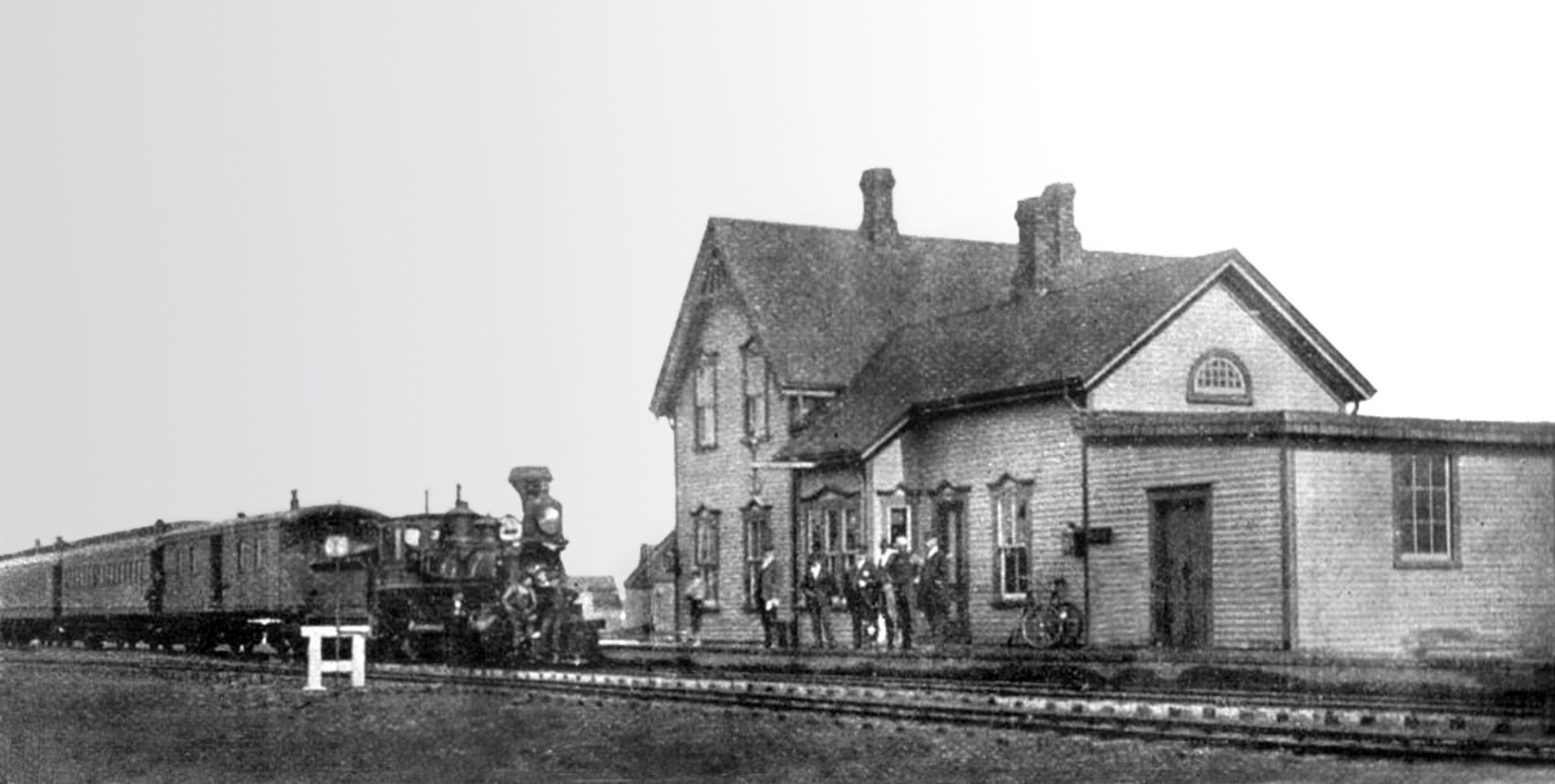
Take the train back to 1886, when the Tignish Railway Station stood as a bustling hub of activity at the western terminus of the Prince Edward Island Railway (PEIR). Built as part of the PEIR’s ambitious development, which began in 1871, the station became operational by 1886, connecting the vibrant community of Tignish to the rest of the island—and beyond.
The railway station wasn’t just a building; it was the lifeline of Tignish, bringing goods, news, and passengers to this westernmost corner of PEI. Farmers relied on the railway to ship their crops, local businesses thrived with improved access to markets, and families welcomed visitors or embarked on their own adventures.
Tignish itself has a fascinating history. Founded in 1799 by eight Acadian families from Malpeque, it later welcomed Irish immigrants in 1811, creating a unique blend of cultures and traditions. The town’s name, derived from the Mi’kmaq word Mtagunich (meaning “paddle”), reflects its deep connection to the natural world and its Indigenous heritage.
By the time the railway arrived, the town had already established itself as a thriving community, with landmarks like the iconic St. Simon & St. Jude Catholic Church showcasing its growth and resilience. The railway station became the heartbeat of the town, enabling commerce, connection, and opportunity.
Though the the trains stopped running in 1989, and the Tignish Railway Station is no longer standing, its legacy remains alive through the Confederation Trail, which follows the old railway route. This trail is now a cherished recreational path that invites Islanders and visitors to explore the beauty of PEI while tracing the footsteps of history.
Rediscover the spirit of Tignish! Today, Tignish is a charming community that honors its rich history while continuing to thrive in the present. Next time you visit, walk or cycle along the Confederation Trail to experience the history and charm of this vibrant community.

